Runners tend to talk about shoes, distance and pace. Fewer talk about the thing underneath all three, which is how the body actually moves from one stride to the next. A gait assessment looks at exactly that, and for anyone curious about their own running it is one of the more interesting parts of sport-related foot care.
Why Look at Movement at All
The Australian Podiatry Association explains that gait simply refers to the way a person walks, and that gait analysis is a system podiatrists use to study how the body moves. During an assessment the body’s movements are observed, measured, recorded and assessed.
The reasoning is that the feet do not work in isolation. The association notes that the body as a whole is involved, and that how one part moves can have a bearing on the joints and muscles around it. Looking at a person in motion gives more information than looking at them standing still.
Who Looks Into It
Gait analysis is not only for elite athletes. The association lists people with pain, people who have had an accident, and athletes seeking to improve their performance among those who might have one. Weekend runners, social sport players and people who simply walk a lot are easy to picture in that group.
When the question is about running or training, a sports podiatrist is often the person to ask, since the focus of that work is how feet and lower limbs cope with sport. The assessment is a way of putting a name to observations that might otherwise stay as a vague sense that something feels different.
What a Session Usually Involves
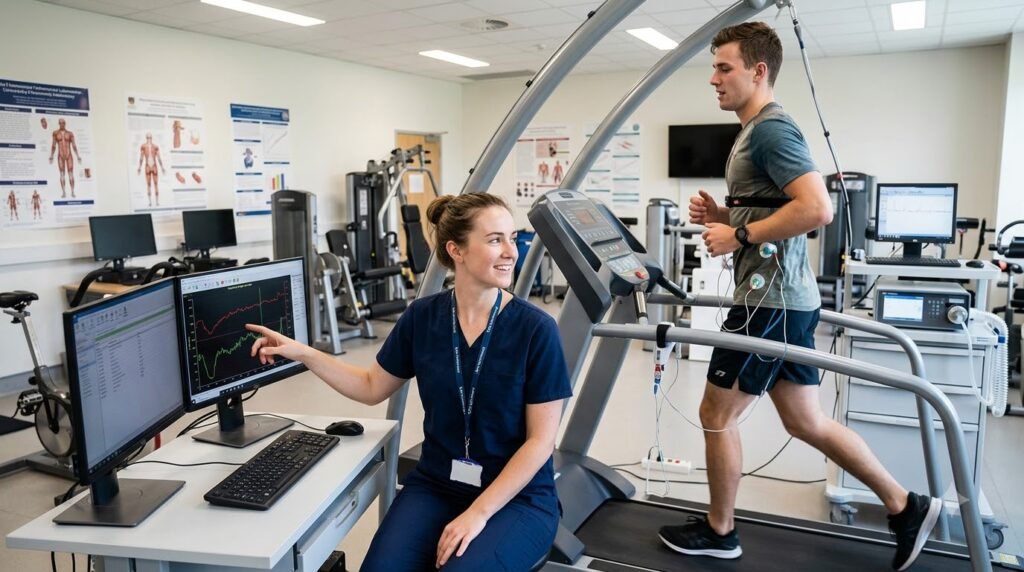
According to the association, a standard assessment asks a person to stand, walk and run on a treadmill, and probably on a normal floor too. Movement may be filmed from several angles so it can be played back and watched again, and sensors are sometimes used in more complex analyses.
Reviewing footage can be revealing, because many people have never seen themselves run. Small habits, such as how the foot lands or how the ankle rolls, are hard to notice from the inside but easy to spot on playback. It is also a chance to ask questions while the recording is on the screen.
Getting Ready
A little preparation makes the session more useful. Wearing or bringing the shoes normally used for running gives the practitioner something to look at. A rough outline of recent training, such as how often a person runs, on what surfaces and whether anything has changed lately, adds context. It is also worth noting any moments where something feels odd, even if it does not hurt.
Comfortable clothing that allows the legs to be seen is usually the practical choice.
Making Sense of the Results
An assessment is best read as information, not a verdict. Two runners with a similar pattern can have quite different needs, and a pattern that looks unusual is not automatically a problem. What matters is how it fits the individual, their training and their goals.
From there, a podiatrist may discuss what, if anything, could be worth changing, and the details will depend on the person. The association’s page speaks in general terms about treatments and exercises being prescribed for a specific issue. It does not promise a particular result, and neither should anyone describing what an assessment will do for them.
Fitting It Into Training
Most runners find that knowledge is only useful when it fits into a routine they can maintain. The Australian Government’s physical activity guidelines make a point that applies here: doing any physical activity is better than doing none, and people who are starting out are encouraged to build up slowly. That applies to changes in technique, footwear or training load as much as it does to a first jog around the block.
Spreading changes out, and not making several at once, makes it easier to tell what is helping.
Keeping the Bigger Picture
Running is usually done for enjoyment, fitness or a sense of achievement, and an assessment is simply one way of getting to know the body doing the work. For anyone who has wondered how they move, or who is returning to sport after time away, it is a practical place to start a conversation.
This is general information drawn from published guidance and does not replace advice from a podiatrist or doctor who has assessed the person concerned.